Secure Boot Key Diagrams
What is Secure Boot?
Simply put, Secure Boot is an implementation of code signing, usable in the firmware boot environment. In the commercial software world, it is common for software developers to sign their code. Secure production networks can deploy policies that allow only signed code to run. Using an allow-list of signing certificates is highly effective as an anti-malware mechanism. Secure Boot brings that practice to consumer devices to prevent malware in a device’s privileged execution mode.
KEK updates
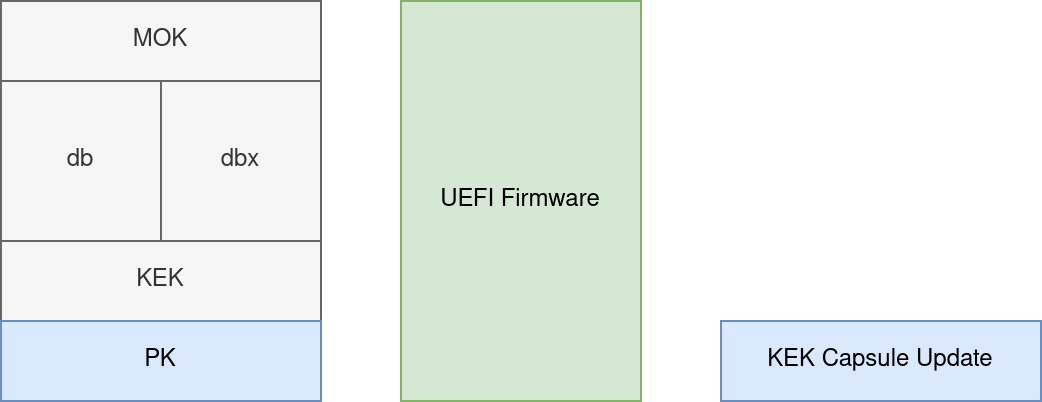
The Platform Key (PK) is the trust root for a system. It is typically a key owned by the device manufacturer. If the system boots and finds a capsule update for the Key Exchange Key (KEK), the update must be signed by the PK. If the KEK update has a valid signature from the PK, then the system will update its KEK.
DB/DBX updates
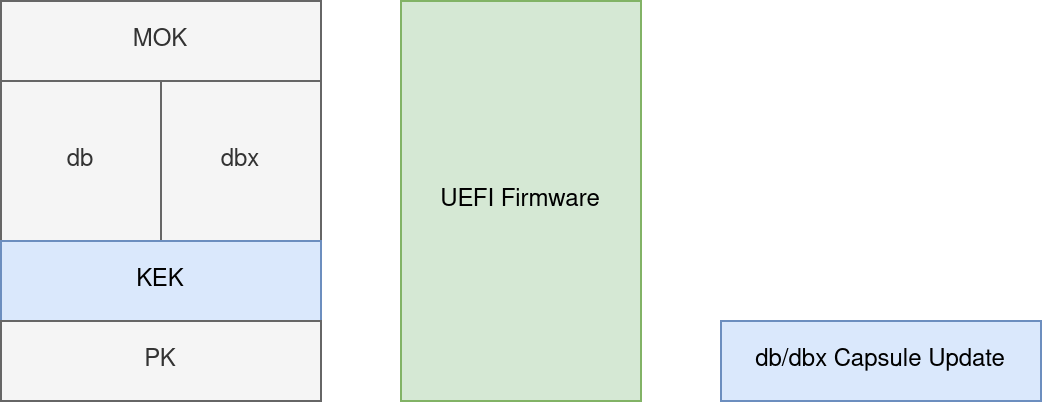
The Key Exchange Key (KEK) serves a similar purpose, but is typically a key managed by an OS vendor like Microsoft. The KEK is used to authorize updates to the allowed signature database (db) and revoked signature database (dbx). If the system boots and finds a capsule update for the db/dbx, the update must be signed by the KEK.
Booting a Linux operating system with shim and GRUB2
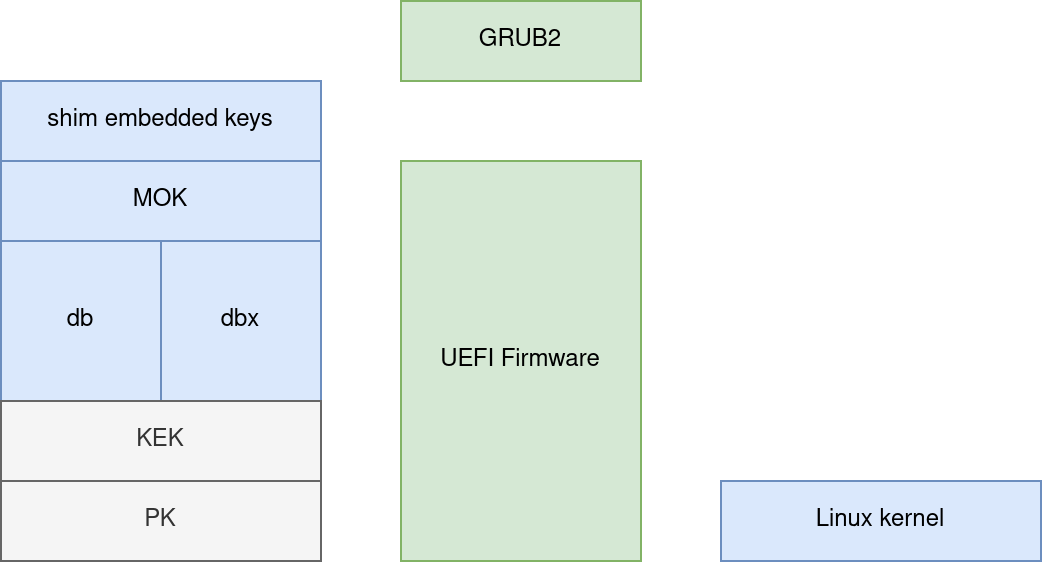
When a PC boots, the firmware will use the UEFI Boot Manager to select an executable program to run. For many GNU/Linux systems, this will be “shim”. The Boot Manager will provide the location of a file, and the firmware will validate the signature of that file against the dbx, the db, and the MOK. If the file is disallowed by the dbx, then it will not execute. If it is allowed by the db or the MOK, then the firmware will begin executing the code in that file.
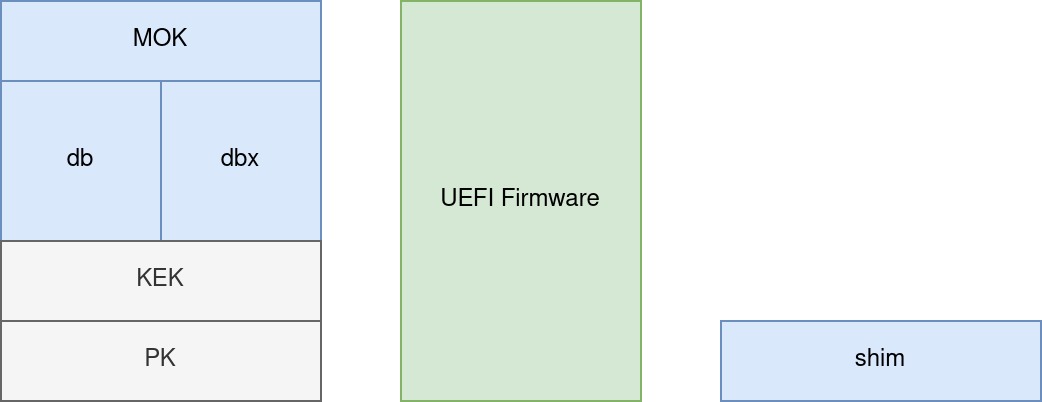
shim embeds signing keys of its own in its executable file. When it runs, those keys can be used to verify code that is loaded later on. shim is designed to be as small as possible so that it needs to be signed by a db key infrequently, while allowing the distribution vendor to sign and update a more complete boot loader as often as necessary.
Like the firmware, shim will locate a file containing GRUB2. It will verify that GRUB2 has a valid signature, and that the key that signed GRUB2 is not in the dbx, and that it is in the db, or the MOK, or in the keys that were embedded in shim when it was compiled.
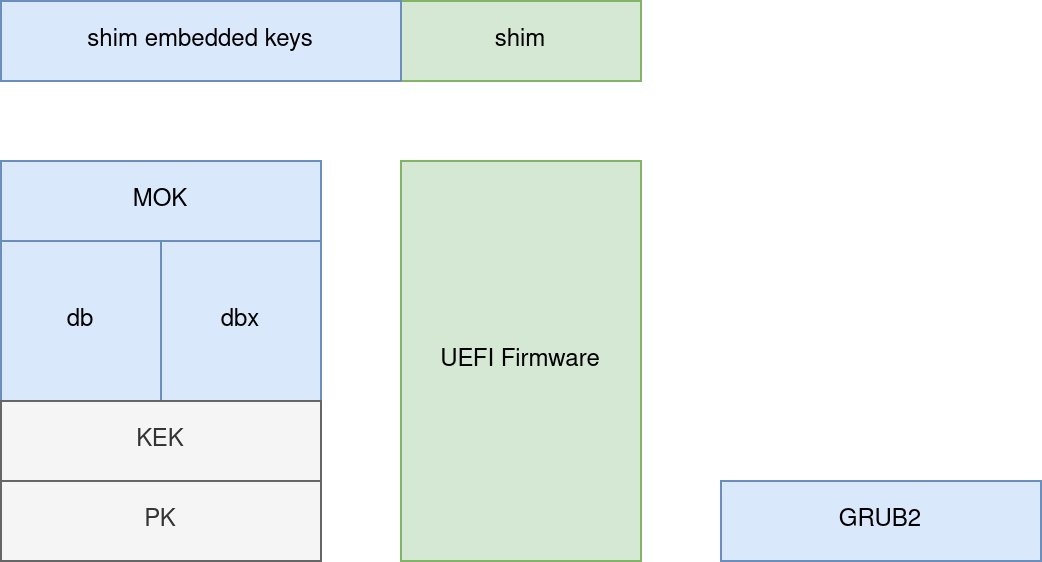
GRUB2 continues this process. It loads its configuration files in order to locate a kernel and initramfs. Similar to earlier stages, GRUB2 will verify that the kernel has a valid signature, that the key that signed the kernel is not in the dbx, and that it is in the db, or the MOK, or in the keys that were embedded in shim.
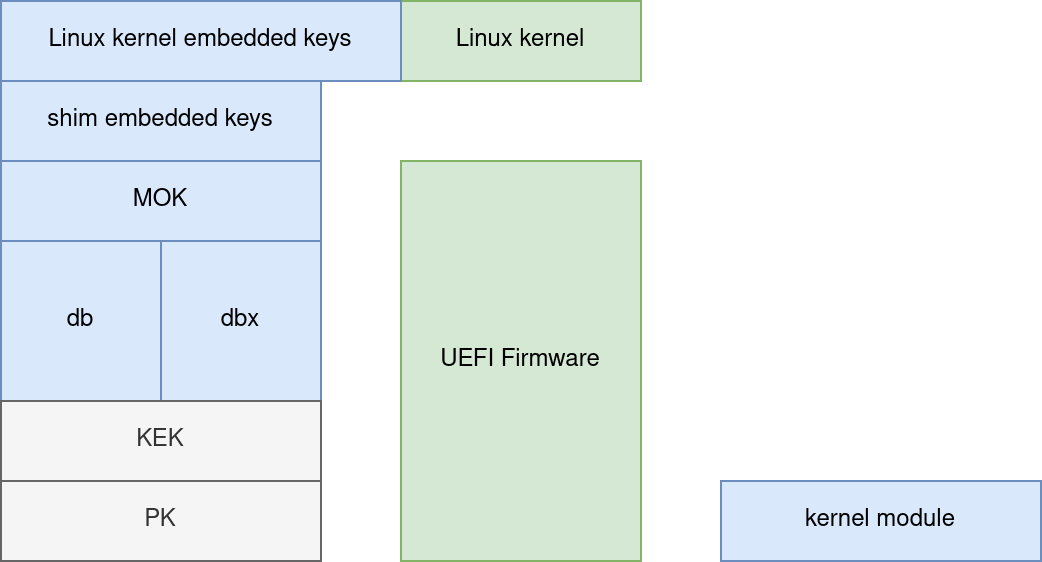
Finally, if the kernel enforces module signing (which is typical on a Secure Boot system), then it will perform a similar process. Like shim, the kernel embeds additional keys, including keys that were generated when the kernel was compiled, used to sign its set of kernel modules, and then discarded. When it loads a kernel module, it will verify that the module has a valid signature, that the key that signed the module is not in the dbx, and that it is in the db, or the MOK, or the keys that were embedded in shim, or in the keys that were embedded in the kernel image.
References
- Red Hat Enterprise Linux - Release Notes - Chapter 23. Signing a kernel and modules for Secure Boot
- Red Hat Customer Portal - What is UEFI Secure Boot and how it works?
- Microsoft Ignite - Windows Secure Boot Key Creation and Management Guidance
- Microsoft Hardware Dev Center - Microsoft UEFI Signing Requirements